Showing posts with label dairy farm. Show all posts

Thursday, February 27, 2020

Red Ferns, Green Beans, and Barnyard Dreams

Farm on property first owned by Isaac Cummings

Crisp, trifold papers encased in heavier red and green covers are spilling out of a folder, and onto the table. Did you know about the coins? 

“It was good luck, customary, to hide a coin in the house for good luck,” says Rick Brain, owner of the barn at the top of what is now called Smith Road, in Forestville. 

According to Rick, he was helping his grandfather put a new roof on his grandparent’s home. He spotted a flash of silver, and asked his “gramps” to hand it to him. His grandfather, Henry R. Egbert, assumed it was a washer and was agitated at Rick’s persistence, but eventually handed over the coin. 

“I said hey, this is a silver dollar!” Rick recalls. “And from that point on, we argued over who had found that coin. So grandma took it and said she was going to keep it for us. At that time, it was probably worth $40-$50.” 

The coin was dated 1856. Time stole the memory of Rick’s grandmother, Dale Egbert, and the coin was lost. The date, however, lives in Rick’s memory: 1856. 

Back to those sharply folded papers — typewritten deeds — and lots of them! Name after name is read as each ancient page is unfolded. Ultimately, Rick and his wife, Lisa Cislo, arrive at the first owner of the property: Isaac Cummings. Cummings purchased the land from the Holland Land Company in 1836.

Though the coin may be the only clue as to when the structures were added to the property, the details and stories grow richer as the discussion moves to present-day. 

Fernside
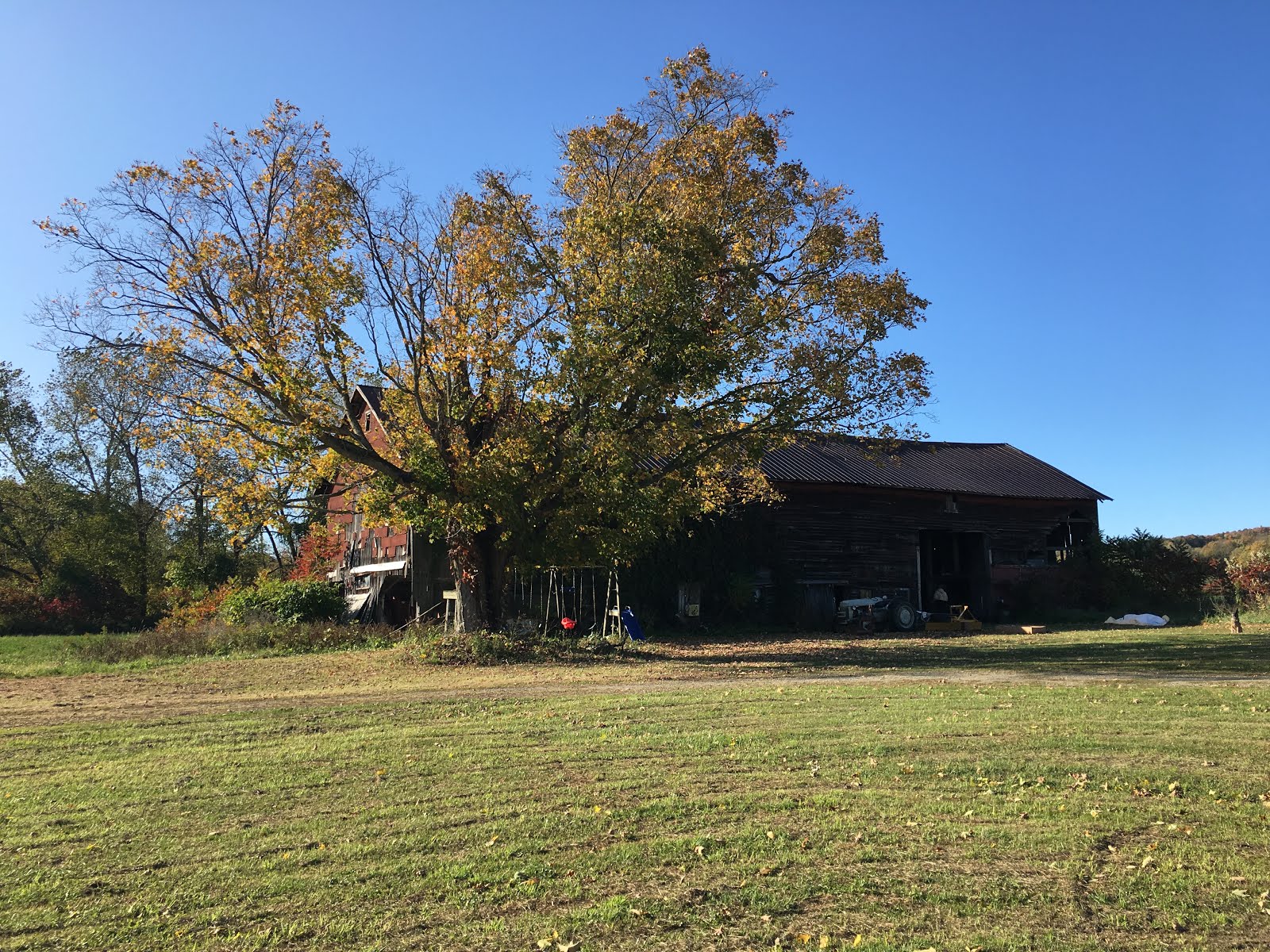
The barn currently stands in a traditional shade of red. A word is printed on the North side of the structure: Fernside. Rick says the writing predates his grandfather’s purchase of the property in 1954. They have no knowledge of the meaning. As you walk through the inside of the barn, it becomes clear that red wasn’t its original color. 

At one time at least, the barn was green, and it wasn’t a dairy barn. 

Built in three stages, the barn has stalls for horses and pigs, and a chicken coop in the upstairs. There was a small silo that may have been made entirely of wood. Rick can still show how acetylene traveled underground between the house and barn and was used to illuminate them both. The remnants of a creamery were found in the basement of the home. It appears this barn was not built for any commercial intent - but simply to meet the needs of the family living there. 

“Gramps” was the first dairy farmer to ship commercially from this location. He spent countless hours on nights and weekends, revamping the barn to accommodate milking 30 Holstein cows and all the equipment he would need. At first, the equipment included milking machines that strapped on to the cow, and a cooler big enough to hold milk cans. Later, he upgraded to a bulk tank. Henry also became a milk hauler and then attained a license to be able to read milk weights. In later years, Henry worked for the town of Villenova; operating both the snow plow and dump truck.

Having lived through the depression, Henry was a thrifty farmer. He kept every rusty nail and bolt he ever had used, just in case he might need it. If something broke, he would spend endless hours searching for something he already owned that might serve to get him through. Running to town to purchase parts was not ever an option Henry chose if he could somehow avoid it.

An animal lover, Henry didn’t keep to a consistent practice of culling his herd. He stuck to his pragmatic ways by only feeding the cattle whatever was least expensive. For many years, the answer was bean snips. 
“There was a canning factory down in South Dayton,” Rick shares. “The last thing they processed were beans. They had the bean snips: the waste.” 

Since Henry had two dump trucks, one could stay at the canning factory, and a loaded one would be brought home. “We had made a bunker [to store the beans] on a cement pad, and that was how we fed them. And the cows made SO much milk off of that! And it was free! Gramps loved that!”

Nothing replaced the quality and affordability of bean snips when the canning factory was shut down. The cows grazed on hay in fields around the farm. The effects of that are still apparent today, as the ground is still rough from cow hooves plodding through the fields when they were soft from rains or a spring thaw. 

While it was running on a shoestring, the farm didn’t stay current. Generations of family that might have been interested in continuing the farm found Henry rigid in his methods. Anyone thinking they might want to continue the legacy was faced with a sizable investment to update equipment and advance to a more modern operation. 

“I definitely wanted to take over the farm,” Rick shares. When asked if he favored the cows or machinery, he replies  “Both. Because I loved it all.”

In 1986, Henry encouraged Rick to go to college “and then we’ll see.” Only Gramps never became ready to hand over the reins to anyone. As he speaks, the gravity of all he would have had to do to make his Gramp's farm a profitable business seems to settle in. 

Photos Courtesy SLP Photography
Nevertheless, the spark of Rick’s hopes and dreams is still alive. He had wanted to add more cows and had a goal of being a Dairy of Distinction. He still thinks about owning his own dairy operation, which would include a processing facility. The reality is ever-present though.

Rick knows now he could never get into dairy.

“It costs too much to milk cows and there’s no money in it,” Rick explains. “It kind of scares me, thinking about this area and how many farms there used to be. Now there is one, and he is leaving. So, I mean… there’s going to be nobody up here.” 

He and Lisa imagine other ideas for their  barn that lend themselves to agri-tourism: a pumpkin farm, corn maze, raising beef cows, maple syrup… for creative people, the options seem endless. For now, Rick is a sought after, self-employed contractor. From woodwork to electrical to plumbing, many of the skills he employs on the job as Cranium Remodeling saw their beginnings on the farm. 

“My Gramps and Annie, my aunt, they both asked me ‘how in the hell did you learn to do everything you do?” Rick shares, “it’s from watching, and I learned that from Gramps because he would always say ‘pay attention,’ you know? ‘You can learn a lot if you watch,’ and that’s what I did. I just picked things up.”

The differences between how Henry made repairs and how Rick now approaches his work become more apparent throughout the conversation. Henry, as was the common practice of his generation, Made Do. “Doing it right” has been Rick’s intent from his earliest inclinations. It’s clear that Henry’s creativity in keeping things up-and-running influenced Rick’s ability to approach his work with an open mind; create his own plans for his clients; as well as understand their ideas and be able to incorporate them into his processes. 

“Gramps was getting by.” Lisa observes. “You’re doing it to make a living.”

Rick shares that traveling gives him some peace of mind. “We go camping in North Java, and I like going the scenic route because there are so many farms up there still. It restores my faith in farming, but I know it’s still disappearing because the younger generations just don’t want to do it and it’s so darned expensive you can’t make it if you try — unless you have a couple of thousand cows to milk, you can’t make any money and then it costs so much to keep a couple of thousand cows… you’re so far in debt it’s not even funny.”

“I’d really like to see the mom and pop farms come back,” Rick concludes. 


Monday, February 17, 2020

It IS a Diary, After All.

It's been a busy weekend, and thankfully a long one! Yesterday, which is usually a day I set aside time to write and work on the blog, I had a young man in need of costume alterations for his school play. The day was spent making buttonholes on my grandmother's 1950's era sewing machine, with a buttonhole attachment which I had never figured out how to use before. Thanks so much to YouTube! It's a pretty incredible little gizmo.

So today, some blog work is happening. I'm going through the recordings of my last interview. I keep my computer handy for transcribing the important parts; but I'm usually cleaning house while I listen. I'm excited to get this one written! There are so many interesting points to explore. It's interesting to look at families where a grandparent and grandchild are working together. It's a lot like what's happening with my daughter and my dad. I quite often stay out of it on purpose. My relationship with my grandmother was one of the greatest blessings of my life. She had far more influence on me than my parents. And now, as I look for mentors and role models for my girl, I can't imagine a better guide in life than my dad.

Simple symbiosis.
Autumn and Satin

Today though, I stepped in a little and helped the girl work with her calves, Satin and Julia. Of course, that ended in teenage angst! This is why I rely on my dad so much. Julia has a clever pen my dad creates for young calves. Autumn didn't think we should take Julia out of her pen. I was determined to show her it was no big deal and NOW is the time to start working with this calf! My releasing the side of the pen that grandpa had put together was simply not OK in Autumn's world. After quite a bit of tense talk, the pen was put back together and Autumn stormed out of the barn.

NO, she isn't a brat. Autumn's world is not the same as ours. If you know her, you get it, at least to some degree. The hard part to explain is what trying to manage and balance all of that does to a parent. It's honestly hard for me to understand my own emotions and how raising her has changed me. It's an absolute given I am going to push too far at some point. I guess all parents do. I can't really explain what happens in me when things go awry with her. I have two kids, and they are entirely different beings. Things go awry with the boy too. At 14, he is a different kind of exhausting. Even at his worst, there is some level of logic and reason that can still be reached.

When Autumn shuts down, it's an entirely different story. This isn't a simple symbiosis, and it never has been. Parenting her happens at such a primal level in so many ways.

Her grandpa always seems to strike the perfect balance. He may never fully understand the peace of mind he brings me - and the value of the freedom he has given his granddaughter. He considers himself a cow man, first and foremost. His daughter considers him a hero, and always will.

How funny that what I actually logged on to write about was the relationship between cows and people.

It is a diary, after all. Might as well mental purge in a post...

I was on Facebook, which I rather think I'd like to cut right out of my life. Still, there I was. A "User." I heard a speaker once say that there are really only two times humans are referred to as "users:" when they are using technology, and when they are using drugs. Interesting, isn't it?

While on Facebook, I saw a post by a couple of young agvocates I follow. The problem I had was in the comments. The endless, bullying comments by those aiming to end agriculture. Comments full of misinformation and looking for a fight. Misinformed internet trolls who blatantly state they will not rest until the dairy industry is dead.

Those people make me so, so sad.

In a few ways, they are the reason I started this digital diary around a decade ago. They are so far removed from agriculture. They really don't understand how the industry works. Originally, I wanted to capture my experiences, having returned back to our family farm after a near 20-year hiatus. I had realized how much I enjoyed the cows. I had become fully aware of how alive I felt - going to work in jeans and workboots and moving around cows for a few hours each day. THIS was the best symbiosis! I find animals to be incredibly soothing. This was definitely a personal period of my working through so much bottled up stuff around my early stages of parenting. The cows and those hours in the barn were the best therapy I could have asked for.

Still, there was a real sense that it may not last. Even if it did, the chances my children would farm were slim. The chances their children would farm were nil. So to capture some little piece of it so they could look back at mom/grandma's memories and have a feel for what farming is. My idea was to create digital place that stood against the misinformation and horrible videos that are edited and created (and now we know, literally staged!) to capture farming in the worst possible light. I wanted to be someone tangible, believable, and accessible.

But you know, even that is a scary proposition today. I see what the trolls say and how mean they are. In their words, there is no dignity or respect for a different viewpoint. There is no willingness to listen with an open mind and absorb something they have clearly never experienced. It makes me hope my little Barn Diva page never gets so big as to attract that kind of attention.

So while it is little and pretty inconsequential, I'm going to just rant a little. What in the world do the activists think happens to the animals, if farming is ended? Do they imagine cows roaming the woods? Deer roam the woods, and they also pop out on the roads at the worst possible times. Can you imagine connecting to a cow with the hood of your car?

That is why deer are hunted - to control the population. So, would cows be hunted? And in this free-range scenario, how are the cows fed? Is grazing on grass enough for them? How do they survive in the woods in the winter? In the barn, none of this is an issue. OH - and can we imagine in our wooded scenario how the cows are dealing with mange, lice, grub infestation, hardware disease?

Or maybe there just aren't any more cows? We just let them be extinct? How is that better?

Symbiosis. Living a mutually beneficial life. Our animals enrich our lives in so many ways. Make no mistake, we give them comfort, shelter, food, health care, safe pastures and free spaces to move...

I just really don't get it. HOW did we get so removed from this way of life that we have actors on television talking about raped cows and farmers ripping cow babies away from their mothers?

Saturday, February 1, 2020

The Farm Phoenix of Forestville

Farmstead owned by Raymond J. Ortel Jr.
Located on a hilltop just outside of Forestville lies a farmstead that blends past and present. In its prime, it housed purebred registered Holsteins, and then grade cattle. It was the mainstay that provided for a family of five, and laid the foundational concepts of responsibility and work ethic for the grandchildren that helped continue the legacy into the beginning of a new century.

For those who knew him, Raymond J. Ortel Jr. was a determined, decisive man. He knew it took hard work to keep a farm running, and was unafraid of driving those concepts home for anyone who worked on his farm. His grandson, Garrett Pfleuger, shares some insight into how the farm worked when he was growing up.

Extension built by the Ortel brothers. 
Though it is uncertain when the original barn was built, a young Ray and his wife bought the farm in the mid-1950's from a man with the last name Saltmeyer. Ray and Darlene raised three "Barn Divas:" Becky, Brenda, and Bonnie. As they grew, each had a hand in keeping the farm profitable. Despite their involvement, it was hard for any of them to imagine taking over the family farm.

According to Ray's daughter, Brenda Ortel Bentley, the extension shown in the photograph shown here was built by Ray, his three brothers: Terry, Dallas, and Sidney, and their father, Raymond C. Ortel Sr. "All the fine carpentry was Uncle Dal's handiwork and part of that generation was the stories handed down while they worked on projects together. Just go listen to Uncle Sid for an afternoon."

Garrett Pfleuger on his grandpa's farm.
In the early decades, the Ray-Dee Farm housed registered Holstein cattle. By the time Garrett was actively involved, the herd consisted of unregistered, or grade cattle. Though he never discussed with Garrett the reasons why he stopped registering cattle, it's possible it became an expense that could no longer be justified.

The herd was dispersed twice. In 1980, all the animals sold were registered. The next year, a scheduled increase in dairy price supports was eliminated, which affected approximately 15,000 dairy farmers in New York state alone. As the young stock matured into milking cows, the herd reformed. By the 1990's and into the next century, Garrett was also growing into an important part of the day-to-day operations. His younger brother, Wade, was working alongside their grandfather as well. Garrett had thoughts of taking over the family farm, and ultimately decided against it.

"I didn't think it would be a good move," Garrett explains. "I could see the market kind of falling behind and it seemed like everyone else was getting out."

Ray received a cancer diagnosis, and continued to milk cows as long as he could. When things became difficult, Brenda recalls "the entire community came to help."

When he was no longer able, the entire herd was dispersed. "Everyone stood in the yard (during the sale), and he sat in the yard and watched them all sell," Garrett remembers. We can only guess at what thoughts ran through his mind that day. "He never talked about that stuff, at least to me."

Brenda warmly adds, "When Raymond J. Ortel departed this earth plane, we lost an amazing farmer, provider, and storyteller. His legacy lives on and is woven into the fabric of the barn, cows, crops and very land he cultivated."

New structure built over the original Ortel foundation
Courtesy SLP Photography
Ray passed away in 2000, and the barn stood empty for a few years. It was then rented for a few years, and then sold. It remained a milking facility until a fire brought it to the ground. Though the farm was rebuilt on the original foundation; memories of the original hand-hewn, peg and beam structure are all that remain. "I used to climb around there when I was a kid," recalls the man who still holds a great appreciation for good craftsmanship.
"It's tough to see. There are so many barns — nice barns — that are still standing and people don't even use anymore."

Garrett has remained tied to the agricultural industry. As an Ag Technician for LandPro, Garrett makes good use of the work ethic he was taught on his grandfather's farm. "I learned a lot of things working on the farm with Grandpa," Garrett shares. "When I'm working on a customer's equipment, [there is an] urgency to get the equipment working again, and fixed right the first time... Time is money and when we had breakdowns we were up against both Mother Nature and time. I think about that when I'm on service calls."


Sunday, January 19, 2020

About Your Barn...

Anyone who agrees to share their barn story with me will find a similar line of questions. This is a jumping-off point. The questions are designed to unearth the unique path each story takes. I can't wait for this blog to be a collection of local agricultural history!

Eleven Questions:

1) Where is your barn located?

2) When was your barn built?

3) Who built  your barn?

4) What was the original purpose of your barn?

5) Have there been any renovations to the structure?

6) Why is this barn special or meaningful to you?

7) What other purposes has your barn served?

8) What is the current purpose of your barn?

9) What is your favorite memory in this barn?

10) What would you like to see happen with your barn in the future?

11) If you created a time capsule, using elements from your barn, what would be in it?

If this looks easy enough to complete, here's a link to a Google Form with these questions. You can complete it online and get a jump on the process!

Monday, January 13, 2020

Barnyard Perspective

Have you ever seen this barn?
Photo courtesy SLP Photography


You have! It's our barn! If you've driven by, then you know this side. But all I've shown on the internet is this side:

Does it look like the same place to you? Our barn has two different looks: one side covered in tin, the other likely the original barn board siding.

My cousin (and treasured friend), Stacey, is a photographer. She has blessed this project with her energy and talents. Together, we intend to chronicle the historic agricultural structures around us. What started as a passion project in hopes of energizing the effort to restore this barn is turning into a really joyous adventure with someone I look forward to spending more time with.

Though Stacey's first talent isn't videography, she's helped me and my daughter do some video work for the barn. We're hoping to share some digital tours of the place. I am so impressed and excited to share the recording! I'm learning it may take a YouTube channel to get it done. Stay tuned.

Let's go back to the barn.
When I saw the new image, I was struck by the difference in perspective. I walk nearly every weekend on the road. I see the West side of the barn fairly regularly. Did I ever think to take a picture of it from this angle? Nope. I took a picture the way I see the barn from the side I see it the majority of the time.

How incredible is the new image? Look at the lighting, look at how different it looks! Another eye appreciated it from a completely different angle. Now we have another facet to the story. When we tell the stories of other barns, we will have another set of eyes helping to tell these stories. Our capacity to do this project justice has gained serious depth.

Where this project is concerned, more is more! More energy, more perspectives, and more positive are appreciated.

*********
This year we intend to make the first repairs to our century-old barn. If you would like to help with this, our fledgeling gofundme page is here for you to share or contribute to if you are so inclined.

Sunday, January 5, 2020

All Barns House Hard Choices

Sifting through recordings of interviews is time consuming. Today, it's been done while making dinner. No notes are scribed. It's a run-through to get a sense for the direction each post will take.

Already in this project, several themes have presented themselves.
The evolution of haying is an interesting topic.
So is the evolution of milking cows.
How do old barns become dinosaurs, standing unused?
If they continue to be used, how, and why?

The evolution of farming happens as humans respond to their environment.
That's simply all it is.

Here is an entire blog based on looking at how a certain group of humans have responded to their environment, and how that has changed the face of an industry that has the power to feed the world.

Perhaps the most significant choice any one human makes is their occupation.

By and large, children of farmers are more likely than children not born to a farm family, to become farmers. On-the-job training begins early! All children watch their and model their parents, and when you spend your early years with your parents in a barn... well.

You do what you see. It doesn't matter if you are born to a small farm, or a large one. Nearly all farms are family farms. The family at the helm is actively involved in every aspect. Whether young ones are hanging out with a grandparent, parent, or older sibling, they are sure to absorb some aspect of the farm.

Long ago, it was an automatic assumption that one of the children would take over the farm. Women were often expected to marry and move on. For the sons of a farm family, taking over the family farm was an option.

How do you make that decision?
If it's in your blood (and farming really does get in your blood - even if it isn't your occupation - you do hang on to pieces of it), it's an obvious choice. It may even be the only choice. We all know someone for whom, from birth, their path seemed obvious. Passion for farming is a necessity, and that has become increasingly true. As net profits have progressively sunk, and hours spent working remained steady and/or increased. If you don't love it, you won't last. Even for those that do love it, the economic strain can do serious damage to mental health and interpersonal relationships.

Sometimes the choice is made by environmental factors. Say one dairy farm family had two sons. Each son was given cows. One son's cows gave birth predominantly to females (which make milk, which is what this farm produced); the other son's cows gave birth predominantly to male calves. Males won't produce milk, and so are almost always sold. That son's herd didn't grow. He took it as a sign to choose another occupation. For the record, he was a gifted carpenter, and all was well.

As we progress through history, economics begin to factor in more heavily. This is a time and labor-intensive occupation, and the fact remains, even as dairy farms begin to invest in robotic milking facilities. The knowledge required to operate a farm is all-encompassing: animal health and nutrition, animal husbandry, food safety, horticulture, mechanics, accounting, and even human resources, to broadly name a few of the things one must function well with in order to successfully navigate the business. You can put in a 40-hour day managing the herd, and if you are in the growing or harvesting season, you may have a full night in the fields yet ahead of you. The fact that tractors have headlights could be seen as a blessing, or a curse.

If it is all of this for the farmer, consider for a minute what it is for the farm laborer. It isn't a new problem. As the farmer's budget grows thin, the ability to pay a fair wage for work incomparable to any other industry also declines. Good help becomes increasingly hard to find.

"I thought about it; but I could kind of see where things were going, and it didn't seem like a good choice."

Economic shifts, farms adapting or selling out, and the barns stand as bookmarks in the landscape of our times.

*********
This year we intend to make the first repairs to our century-old barn. If you would like to help with this, our fledgeling gofundme page is here for you to share or contribute to if you are so inclined.

Tuesday, December 31, 2019

Water Flows

Hope springs eternal.

Springs. Why do you suppose the word "springs" was chosen there?
Spring like the season?
Or spring, like water.

Hope flows like water. It seems effortless sometimes. When hope dries up, it's like a well going dry. In a way, water is hope, and hope is water.

Our valley is FULL of water! So much so, that there is a well (many locals are wholly familiar) that runs, just up the road from our house. People come regularly to get water. Some people call it "Jesus's Fountain," perhaps because no one really knows how long it's been there.
Turns out that well was an important piece to how the farm here was once managed.

Imagine, farming before electric and running water.
How?

Milking by hand is a given, naturally.
But once milk is collected, it has to be kept cold to prevent bacteria from forming. That may have been the only thing that was easier in winter - but how did dairy farmers do it in the summer?
With water.
At our old barn, there was a trough of water that cans of milk were sunk into to keep the milk cold. Sometimes, according to Uncle Hank, the water would "fail." So they took their cans of milk to the well down the road. At that time, there was a big trough here. Milk would be kept cold in cans in the trough here overnight.

If you've ever lugged a milk can around, you know they are not light. It doesn't get any better, once they are filled with milk! Horses surely pulled the cans by wagon to the trough, but you still had to get them on and off the wagon, and lowered into the trough, and then back out again.

________________________________________________________________________
Thanks so much for your time reading this post! Work to begin restoring our old barn will begin this spring. To join or share the cause, please visit gf.me/u/w9mhpd

Sunday, December 29, 2019

Great-Uncle Hank

World, I'd like you to meet my great-uncle.
You may already know him. He's a pretty incredible guy!

We're rather meeting him together. I'm getting to know him like I never did, and he is a wealth of inspiration!

Uncle Hank is my late grandmother's brother. My grandma that was the center of my world, and a sizable chunk of my heart to this day. As a child, I remember him visiting at grandma and grandpa's with his family, maybe once a year or so. He was REALLY tall, and largely a stranger to me. I feel like I spent the majority of their time there, being somewhere else.
Great-Uncle Hank carrying my dad.
Our home is the site of his childhood. The family moved here when he was two. Since we moved in, Uncle Hank has made a near-annual visit, usually in October. Even in its sorry current condition, he enjoys seeing the barn. In the early part of this decade, it seemed his way of closing his time in New York, before traveling back to Texas for the winter with his wife.

When he walks through it, he points out the scenes from his most vivid memories. The giant, old maple tree beside the barn is where his grandpa used to park his Model T when he came to help put in hay. There's a certain spot at the edge of the hay mow that he distinctly recalls as the precise point upon which he fell out of the mow and broke his arm.

It was this fall I'd learned that Uncle Hank no longer winters in Texas. He's made his home in New York, and still enjoys coming to see the barn. This year, at 90-years-old, the condition of this place that he once worked and played seemed more important than it had in the past. Uncle Hank noted some places my husband has attempted to patch, and it gave him tremendous hope that we would yet save the barn.

It seemed only right to be honest. As much as we would love to save the barn, it's a matter of finances. As a young(ish) family, living in an obscenely overtaxed area, in a state with an equally obscene cost of living, I didn't know that we would ever have the funds to save the barn before it fell in.

Those were horrible words to hear coming out of my own mouth to this sweet man. Thankfully, they didn't dull his hope, or the twinkle in his eyes (so much like I remember my grandmas!). There's something about Uncle Hank and his wish that energized this buried dream up and out of the depths of my heart.

Something that felt like it might happen eons from now, suddenly gained top priority, and a significantly more urgent deadline.

With a new year just around the corner, I'm opening myself to faith, and creating one (of a few yet to be pursued, this is just the fastest) avenue to make a milestone in the big dream possible: making the first repairs to our old barn. If you would like to help with this, our fledgeling gofundme page is here for you to share or contribute to if you are so inclined.

No matter what, thanks so much for reading along so far.

Sunday, November 3, 2019

Telling the Story

Last week I told you about the 8.6 billion present-day reasons why our barn needs to be restored.

Now, I'd like to tell you about why the book I've started writing is a story that needs telling and also may create an avenue within which to generate funds that will help renovate the barn.

If you know me - if you've read old Barn Diva posts - you won't be at all surprise to find that for me, it all starts with my time as a dairy princess. Funny it was a job I didn't want, and turned out to be one of the singular most influential experiences of my life!

If you ask a princess, I think you will find similar stories. The program and the experiences it provides, shows you how important it is to share the real-life experiences of living and working on a farm. I remember talking with students in the city schools in our county and realizing how little they knew about farming; and how excited they were to learn about cows! I remember talking to them about the health benefits of dairy products and how engaged they got in learning about how milk would help them grow big and strong.

And those connections, friends?

As a farm kid, I was *never* the first one out to the barn. Seriously, never. I was not a morning person. Chores were not the highlight of my existence. But sometimes when I was out there, I'd think about the kids we were feeding. Sometimes I'd think about the funny stories they'd share ("My dad's a farmer! He milks chickens, dogs, bulls, and sheep!"). It was times like that when I finally understood being a princess was actually an important job.

And today?

Today, being a princess is an even MORE important job.
Because people don't begin to understand what farmers are doing. They don't see that big farms are still family farms. People don't understand that farmers don't make enough on the products they produce to pay their bills. People think plant-based beverages are the same as milk!

Aside: Thank you to our past princesses for your time and efforts for the industry. To the princesses of today - keep up the good work and KNOW your mission is an important one!

And does anyone understand why farms took the path of growth? Does anyone know why small farms are dying?

Yeah. I'm sure I don't fully know it all either. And the funny thing about this whole princess thing is - at least for me and a few of my past-princess friends - the mission really never leaves you. As a nutrition educator today, I still find myself telling the story of farming. Those are truly gratifying moments - it really never gets old!

So the book (or series, because the history of farming is definitely more than one book) will look at the path of farming - as seen through the eyes of a really remarkable child. In telling her story, we'll see how generations of family farms came to be where they are - and why beautiful barns like ours have come to stand as agricultural dinosaurs in the museum of modern agriculture. My hope is to be able to monetize a website and release chapters that - for a donation of your choice - you will be able to purchase and read knowing that your donation is going to restore a part of agricultural history.

It will be vitally important to hear the stories of farms. People who know farming in the early 1900's. People who can speak to the economic eras that pushed farms to change. Those times when there were hard choices to make - what drove you to make the choice you did? Would you change that if you could go back?

I am thankful to be part of a fantastic farm community! People who have made growing my girl as much a part of their passions as it is mine. This mission is about telling a story that encompasses the stories of the families I love best. It's about making another avenue for people who aren't connected to agriculture to gain some understanding of the generations of love and care that have gone into where we are today.

This IS the story I was meant to write.

Monday, October 21, 2019

Hiatus

/hīˈādəs/
noun
a pause or gap in a sequence, series, or process.
"there was a brief hiatus in the war with France"


  1. Last week, an unintended hiatus in the writing progress happened. Didn't even make it a month before Life Interruptus decided to run naked and screaming while banging cymbals through my routine! Life Interruptus can be a real pain. It can also be really fun. Thankfully, the wild child brought good things.

    Except the update that put my laptop, and my writing on pause. 

    Actually, it was more the evening events happening that put my writing on pause. That and my lack of determination to come home and WRITE the 30 minutes every night that I intended! When discipline decides to get into a competition with sleep, sleep is going to win. Unless the Anxiety trump card gets thrown - and honestly, it did! But what that amounted to was 2AM laundry detail. 

    So I took a week off. There are going to be a couple of nights this week I don't see much writing happening either. 

    The great news is, there are still things to share. Still progress being made.

    Not barn progress per se, but things that maybe will get to live in the barn someday progress. 

    *****WARNING***** PLEASE READ NO FURTHER IF YOU CANNOT KEEP A SECRET****


    You see, I have a kiddo turning 18 next month. 
    Yes, EIGHTEEN. Every parent will tell you their kid is not like any other kid. Every parent will tell you their kid is special. Mine is too. She's not going to college. We're not sure what the future holds for her. There's one thing we know:
    The girl LOVES cows. 

    She says "cows are my spirit animal." Good thing she was born to a family that is still connected to farm, right? 

    She was born to a family that has registered Holsteins. She loves them!
    And she also loves Brown Swiss.
    Oh Me Too!
    Except, I've never owned a Brown Swiss. Never even considered that one. 
    My girl on the other hand... She's considered owning a Brown Swiss. A couple of years ago, my girl decided one day, she was GOING to own a Brown Swiss. 

    SO, for my soon-to-be 18-year-old, who will not have me wringing my hands over helping her fund tuition, there will be a Brown Swiss Calf. The Good Lord Willing and all goes well, she will be a show calf and the beginning of my girl's very own Brown Swiss cow family. My dad is the cattleman in our little tribe. My girl is incredibly lucky to have him invested in this journey, and ready to help her with trying to develop her own Brown Swiss cow family. I love their relationship and am greatly looking forward to being in the back seat on their journey. 

    My girl is also an alternate dairy princess for our county. She's excited her grandpa is taking her to an event this week. She said "I get grandpa all to myself! I'm his partner in crime." 

    Sometimes she says things like that, and when she walks away I just look up and breathe "thank you." 

    My dad is for my girl what his mom was for me... the greatest blessing in life. Everyone should get to have someone like that.

    So for those of you who know her and have shared links about cow cuddling... know that still whirls in my mind. Those of you who know her know what cows and farm have done for her. Those in the therapy fields who know her understand that there may be no better therapy on earth than FARM. 

    It's time you also know there is a vision here that sees us one day sharing the opportunities my girl has had with other humans - especially the ones that aren't like others - the ones that are special. 

    The writing will come back. Last week, we were living. The spice for the writing is in the living. 

Sunday, October 13, 2019

This Old Barn

The funny thing is, it isn't as if this old barn is something I just became aware of. If you haven't been here, you may not be aware that I live on the homestead that my grandma was raised on. You may not  know that as a child, I assumed this would be my place: the giant old house that once stood here and that I used to sneak into when vacant to play and daydream, would be where I lived.

Sadly, the house was deemed in ill-repair and used as a controlled burned for our local fire department the day (seriously, like as I was leaving) I left to attend college in Wilmington, Ohio. The flames of my dream ignited my rearview mirror, as tears washed my face, but failed to clear the vision from my mind even after six hours of trying. At the time, I thought that was the final indication that I wasn't meant to live in New York.

Imagine the moment when, 13 years later, my husband asked if I would like to move home. In the first place, the man is a diehard Buckeye! I couldn't imagine he would ever want to live in New York again (he had for a year or two - it wasn't magical). I weighed carefully... yeah, no. Not really. I didn't weigh ALL of my options. Not the ones I should have. I thought about our parents and who at the time seemed better able to travel to see us. I did warn that the taxes would be insane, the cost of living higher... Yet we packed up a giant U-Haul, our little girl and baby boy, and headed east.

My younger self had never told my husband about the plot that would eventually become our home. He had a few other locations in mind - but there was none of that! Older self really wishes I had taken a little bit of time to explain why I bought five acres in exactly NONE of the places he hoped for.

But that was MY house that went up in flames all of those years ago. In my heart it was, at least. And if I couldn't have grandma's house, then at least I could have the ground she'd played on.

And of course, the barn is still here. In that barn lies my mission - maybe OUR mission. Because ultimately, this old barn may be about more than me and my husband. It IS about more than me and my husband. It's about more than our now-young woman and her dreams. It may even be about more than a beloved senior gentleman, his memories and HIS dream!

All will be revealed. For now, it's enough to know that it's time to save this old barn. We'll need all the help we can get to accomplish it. Perhaps, I have a few tricks up my sleeve. We'll see. In the meantime, we're reaching out for advice and assistance. Please do share this post if you know of anyone with any experience or interest in barn restoration! If anyone local knows anything about the history of this barn previous to 1930, we'd love to have that information too.

Thursday, April 22, 2010

This is Me

With the exception of weekends and vacation days, I get up at 6 AM (ok, the alarm goes off at 6, I get up at 6:30), put my children on their respective school buses at 7 and 11, clean my house a little, and go off to work. Once I am there, I am greeted by 64 beautiful black and white faces, as well as a host of babies ranging in age from newborn to about six months old. I turn on the wash cycle, then return to those faces to clean their platforms and get my shift in their home going.

I work at my family dairy farm, and it is the best job I have ever had! I have been a news reporter, copy editor and graphic designer. I still do some of that. But the best part of my day comes when I lace up my work boots, walk across a field to the farm, and shovel – yeah, THAT stuff.

The farm I go to six days a week is about 30 years old; but my family has been a part of the dairy industry for four generations! One of the great parts of being there is watching the fifth generation growing up, and into, this legacy. Between my brother’s family and mine, there are seven children, ranging in age from 21 years to four months old. Four of them show interest in the various areas of the farm. It is my fervent hope there will still be a farm for them to carry forward by the time my brother and I would be ready to pass it to them.

Our farm is quite small. We milk 64 cows. It is a tie stall operation, which means each cow has her own stall. They are let out into a pasture every morning for exercise while their stalls are cleaned and the bedding replaced. Interestingly, we bed them mainly with shredded paper! We get local newspapers, magazines, phone books and other recyclable paper; and my dad shreds it up in a bale shredder, which then blows the paper into the stalls. It is cleaner and much less dusty than sawdust, and more absorbent than straw. It is also endlessly amusing to smell the scent of perfume samples and find pieces of Maxim models under our girls! Cows have laid (and pooped!) on Heidi Klum…

Each cow has her own name. Typically her name starts with the same first initial as her mother. That way we can trace her family history in our minds while we are working. Our cows are registered, which means they have an official pedigree (like an AKC dog or thoroughbred horse). Some of our cows have a richer family history than we do! We not only know who their parents, grandparents and on were; we also know how much milk they made, the quality of the animal itself and the quality of the milk!

The cows are very used to their routine. Most know their names and which stall in the barn is theirs. It changes from time to time. Each cow has a little “vacation”, the time varies but is ideally around two months, where she is turned out to pasture and doesn’t milk. This happens just before she is about to have a calf. Once she calves, her milk returns and she goes back into the barn. Sometimes her stall is changed; but they usually catch on to their new digs quickly.

Like people, cows have different personalities and levels of intelligence. We have favorites, and not so favorites. We have good days, and bad. But everyone who works at our farm is there because they want to be. Because we love what we do. Because we realize it is an honor and a privilege to work as a family, side by side. Because we take pride in creating a high quality food product for the people in this country.

Well, we used to. The sentiment around the farm is changing. It’s not just an economical issue. It’s this growing feeling that the people in this country do not support us. The negativity and criticism about how we care for our animals and produce our milk. The age-old stigma that farmers are stupid and boring. The weight of this farm will soon be passed to the shoulders of my generation, and we are wondering if we want it. Not because we mind the work, not because we don’t enjoy what we do; but because we wonder if we will be the generation to watch government and society destroy the very thing that four generations of us have put our life’s blood into culturing, nurturing and improving. Who would want to watch that?

I think I will set all that aside for today. It is time to milk the cows. If you are interested, I’ll tell you all about it tomorrow.